Last Updated: November 8, 2026
Quick Summary
Booking one shared coach eliminates the stress of coordinating multiple vehicles for family travel, because you manage one pickup, one luggage load and one arrival time instead of several. Every extra vehicle adds a driver, a meeting point and a phone call, so a single coach keeps the whole group together from hotel to terminal.
- Book one vehicle when everyone leaves the same place, for the same place, on the same morning.
- Multiple vehicles only win when the group splits across destinations, arrival days or schedules.
- A large suitcase takes up roughly the space of a seated adult in a car boot.
- Nine or more passengers with cruise luggage makes a coach the practical choice.
- Agree a meeting point, a backup and one coordinator before running any convoy.
Table of Contents
- Why Coordinating Multiple Vehicles for Family Travel Wears Everyone Down
- Coach Transfer Versus Multiple Taxis in London: A Practical Comparison
- The Real Cost of Splitting a Group Across Several Vehicles
- Matching Group Size, Luggage and Passenger Capacity to the Right Vehicle
- Planning a Family Cruise Transfer with Luggage Without the Last-Minute Panic
- Group Transport to Southampton Cruise Terminal: What a Smooth Run Looks Like
- Convoy Protocols, Meeting Points and Tools for Keeping Drivers in Step
- Preparing for Delays, Emergencies and Differing Family Needs
- Frequently Asked Questions
Why Coordinating Multiple Vehicles for Family Travel Wears Everyone Down
Coordinating multiple vehicles for family travel is the quiet reason so many group trips start badly. Coordinating several vehicles for a group is where transport plans most often fall apart, usually before anyone leaves the hotel lobby.
One group books three taxis and a rented people carrier. Someone’s flight lands late; another driver takes a different route. By the time everyone reaches the terminal, half the party is queuing at the wrong entrance and the other half is circling for parking. The stress is coordination, not distance.
Treating vehicle count only as a cost decision overlooks the logistics.
Below, we break down where multiple vehicles quietly cost more than they save, and how a single shared coach removes the coordination problem entirely.
Coach Transfer Versus Multiple Taxis in London: A Practical Comparison
A coach transfer can be a practical alternative to multiple taxis for family travel when the group is staying together and heading to the same destination. The difference is not just cost.
With taxis, you are managing several pickups, several payment conversations and several arrival times. The UK government guidance on passenger transport licensing sets out how these services are regulated, which is worth knowing when you are comparing operators.
The comparison most families need is not coach versus taxi in the abstract, but one shared vehicle versus a convoy of two, three or four, each with its own driver, fuel stop and parking problem.
Side-by-Side Comparison Table
| Factor | Single Coach Transfer | Multiple Taxis or Rental Cars |
|---|---|---|
| Pickup points | One, door-to-door | Several, often scattered across hotels and terminals |
| Luggage handling | Loaded once into the hold | Split across boots, with repeated loading and unloading |
| Arrival timing | Everyone arrives together | Party splits by minutes, sometimes by an hour |
| Cost structure | One group booking | Metered or rented per vehicle, plus fuel and tolls |
| Coordination needed | Minimal | Constant phone calls, meeting points and check-ins |
| Child seating | Arranged in advance | Depends on each taxi or rental, and on each driver |
| Parking | One drop-off at the kerb | Several cars circling for terminal or hotel parking |
| Driver fatigue | None for the group | Shared across family members who should be resting |
When Multiple Vehicles Genuinely Win
Multiple vehicles are genuinely the right choice in a few specific situations.
- The group splits across different destinations. If one branch of the family is heading to a hotel in one part of the city and another is going straight to the terminal, a single coach is the wrong tool.
- The group arrives on different days or at different airports. A coach booked for one arrival time cannot absorb a party that lands six hours later.
- Someone needs to leave early or stay late. A shared vehicle locks everyone to the same schedule, a real constraint for families with medical appointments or work commitments.
- The group is small enough that a coach is poor value. Two adults and two children with light luggage are usually better off in a single taxi or private car than in a coach sized for twenty.
For a cruise departure, these exceptions rarely apply: the whole party is going to the same terminal on the same morning, exactly the scenario where a single vehicle removes the coordination problem rather than shifting it.
The Decision Rule
A simple rule of thumb: if every passenger is leaving from the same place, going to the same place, on the same morning, book one vehicle.
If you are weighing up whether the coach is worth it for a family specifically, our guide on whether a coach transfer to Southampton Cruise Port is worth it for families covers the trade-offs in detail.
The Real Cost of Splitting a Group Across Several Vehicles
Splitting a group across several vehicles looks cheaper on paper and rarely is. The headline fare is only one line in the budget. The rest hides in plain sight.
Consider what a family actually pays when they split up:
- Multiple fares: each taxi or rental is billed separately, with no group discount.
- Fuel and tolls: rental vehicles need filling, and motorway tolls apply per vehicle.
- Parking: several cars at the terminal or hotel means several parking charges.
- Driver time: if family members take turns driving, that is unpaid labour spread across the group.
- Hidden extras: luggage surcharges, child seat fees and waiting time add up per vehicle.
A single shared coach folds all of that into one booking.
The emissions point matters too. Fewer vehicles on the road means a smaller footprint for the same journey, which many families now factor into their plans.
Matching Group Size, Luggage and Passenger Capacity to the Right Vehicle
Matching the vehicle to your group is where many transport plans go wrong, since luggage is often underestimated and boot space overestimated.
The decision comes down to three numbers: how many people are travelling, how many suitcases and pushchairs are coming, and how far you are going. A cruise departure usually means a large suitcase per person plus hand luggage; add a pushchair, travel cot or mobility equipment, and a standard taxi boot fills fast.
A Capacity Guide You Can Actually Use
Use this guide as a starting point, then confirm with the operator, because vehicle specifications vary.
- Under 4 passengers, light luggage: a single taxi or private car is fine. Boot space is rarely the limiting factor.
- 5 to 8 passengers, mixed luggage: a larger vehicle is usually needed, and luggage space is often the limiting factor.
- 9 or more passengers with cruise luggage: a coach is the practical choice for group travel.
A useful rule of thumb: a large suitcase takes up roughly the space of a seated adult in a car boot. Packing for a week-long cruise, the luggage often occupies more floor space than the passengers.
Child Seats, Accessibility and Differing Needs
Capacity is not just a headcount. Child seats take up a full seat each, and a child who legally needs a booster cannot be counted as a lap passenger. Tell the operator at booking so seats are arranged in advance rather than improvised at the kerb.
The Total Cost Comparison
A single shared coach folds all of that into one booking.
The emissions point matters too. Fewer vehicles on the road means a smaller footprint for the same journey, which many families now factor into their plans.
If you are checking whether a coach actually fits your group, our page on the type of vehicles we use shows the options and how luggage is loaded.
Planning a Family Cruise Transfer with Luggage Without the Last-Minute Panic
Planning ahead is the best defence against a chaotic departure day. Families who book early, confirm the pickup time and pack with the vehicle in mind avoid almost every problem we see.
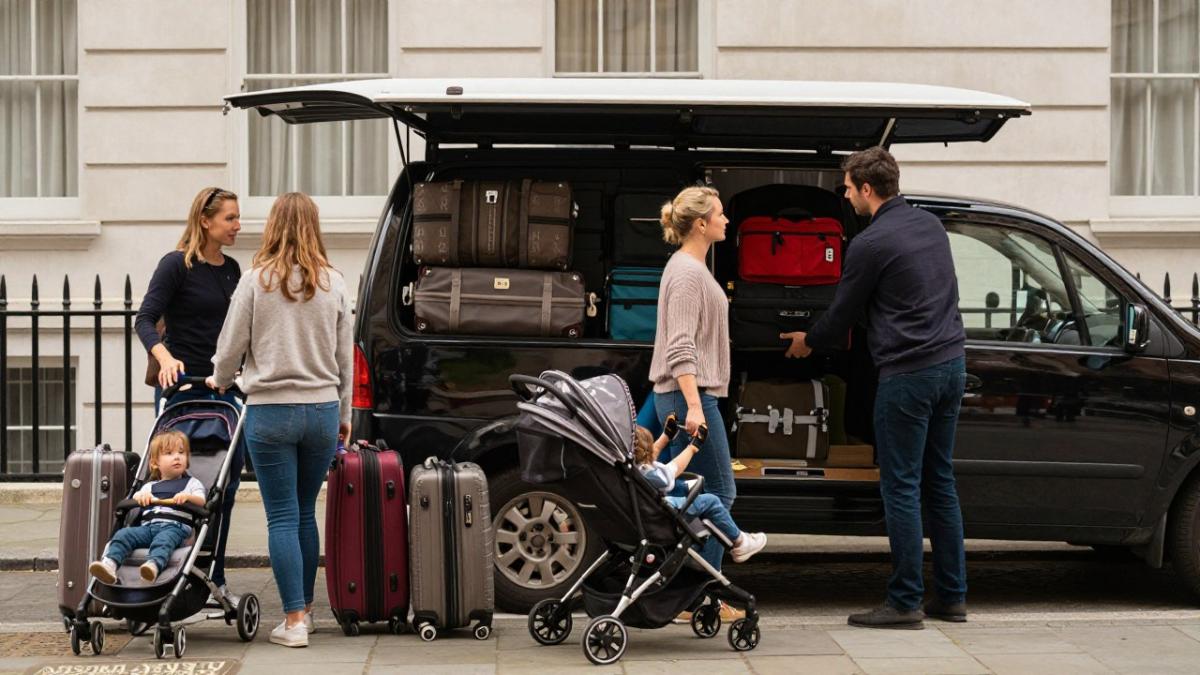
Start with a realistic timeline: work backward from embarkation time and allow a generous buffer for traffic to the terminal.
For a step-by-step walkthrough, our guide on how to book a London to Southampton cruise coach takes you from enquiry to confirmed booking.
Group Transport to Southampton Cruise Terminal: What a Smooth Run Looks Like
A smooth group transfer to Southampton cruise terminal looks almost boring, and that is the point. Everyone leaves together, arrives together and walks to check-in without a single coordination call.
Here is how a good run unfolds:
- The coach collects the whole group from one London hotel or airport.
- Luggage goes straight into the hold, loaded once.
- The driver follows a planned route with a scheduled rest stop.
- The coach arrives at the correct terminal with time to spare.
- Passengers step off refreshed, luggage unloaded at the kerb.
That is the service we run on our London to Southampton transfers, and it is why families tell us the journey itself became part of the holiday rather than a chore.
Keeping Children Comfortable and Entertained on the Road
Children travel far better in a shared coach than in a cramped taxi. There is room to move, a seat for everyone and space to spread out.
A few practical habits help:
- Pack a small activity bag per child with a book, a tablet and headphones.
- Dress children in layers, since coach air conditioning can run cool.
- Plan a snack and a stretch break into the journey.
- Keep comfort items, like a favourite blanket, within reach.
Packing Food, Snacks and Travel Essentials
Pack food and essentials in one accessible bag rather than buried in the hold. You will want water, easy snacks, wet wipes, hand sanitiser and any medication close at hand.
A simple checklist keeps packing calm:
- Water bottles for each passenger
- Non-perishable snacks
- Wet wipes and hand sanitiser
- Any prescription medication
- Chargers and a power bank
- A change of clothes for young children
Watch out: packing snacks in the suitcase instead of a cabin bag is the mistake that leaves hungry children and frustrated parents an hour into the journey.
Convoy Protocols, Meeting Points and Tools for Keeping Drivers in Step
Keeping several drivers in step is possible, but it takes deliberate planning. If you are running multiple vehicles, agree on protocols before the day.
Set a clear meeting point and a backup, share a live location, and nominate one coordinator. Use a group chat for updates and confirm a check-in time at each stop.
Convoy protocols consume attention, since someone has to run the coordination. A single shared vehicle means there is no convoy to keep in step.
Preparing for Delays, Emergencies and Differing Family Needs
Preparing for delays and differing needs is what separates a calm departure from a frantic one. Traffic happens.
Build in a buffer, keep the group’s contact details in one place, and agree what happens if a pickup runs late.
When you are ready to secure your group transfer, you can book your transfer and confirm the details in one step.
Coordinating multiple vehicles for family travel asks a lot of the person holding it all together.
Frequently Asked Questions
Is a coach transfer cheaper than booking several taxis for a family?
When a family or group splits across several taxis, each vehicle carries its own fare. Ask UK London Coaches for a quote to compare the cost of a shared coach with your taxi estimate. Pricing depends on group size, pickup points and date, so request a quote from UK London Coaches for an exact figure before you compare it with multiple taxi fares.
How do you organise transport for a large family with luggage?
Start by counting people, suitcases and any bulky items such as pushchairs or mobility aids, then match that to one vehicle with enough passenger and luggage capacity. Book a door-to-door coach transfer with a direct pickup so no one has to change vehicles with bags. Confirm the pickup time against your cruise embarkation, and keep passports and medication in hand luggage rather than the hold.
How far in advance should you book group transport to Southampton cruise terminal?
Book as soon as your cruise dates are confirmed. Early booking gives you time to confirm the terminal (Mayflower, Horizon or Ocean), agree a pickup window that leaves a buffer for traffic on the route, and share final passenger and luggage numbers. Last-minute bookings limit vehicle choice and can push you back toward multiple taxis.
What should you check when booking a family coach transfer?
Confirm the exact pickup address and time, the terminal drop-off point and what the quote includes, such as luggage and additional pickup stops. Ask the operator how it handles delays and what child seating it can arrange. Keep one phone number for the lead passenger so updates reach the whole group.
